
RockLogik AI
The system

Two devices. One system.

IVAN sensors on the drivetrain and one Firefly hub in the cab. That is the whole installation on a truck. Everything on this page is what ships.

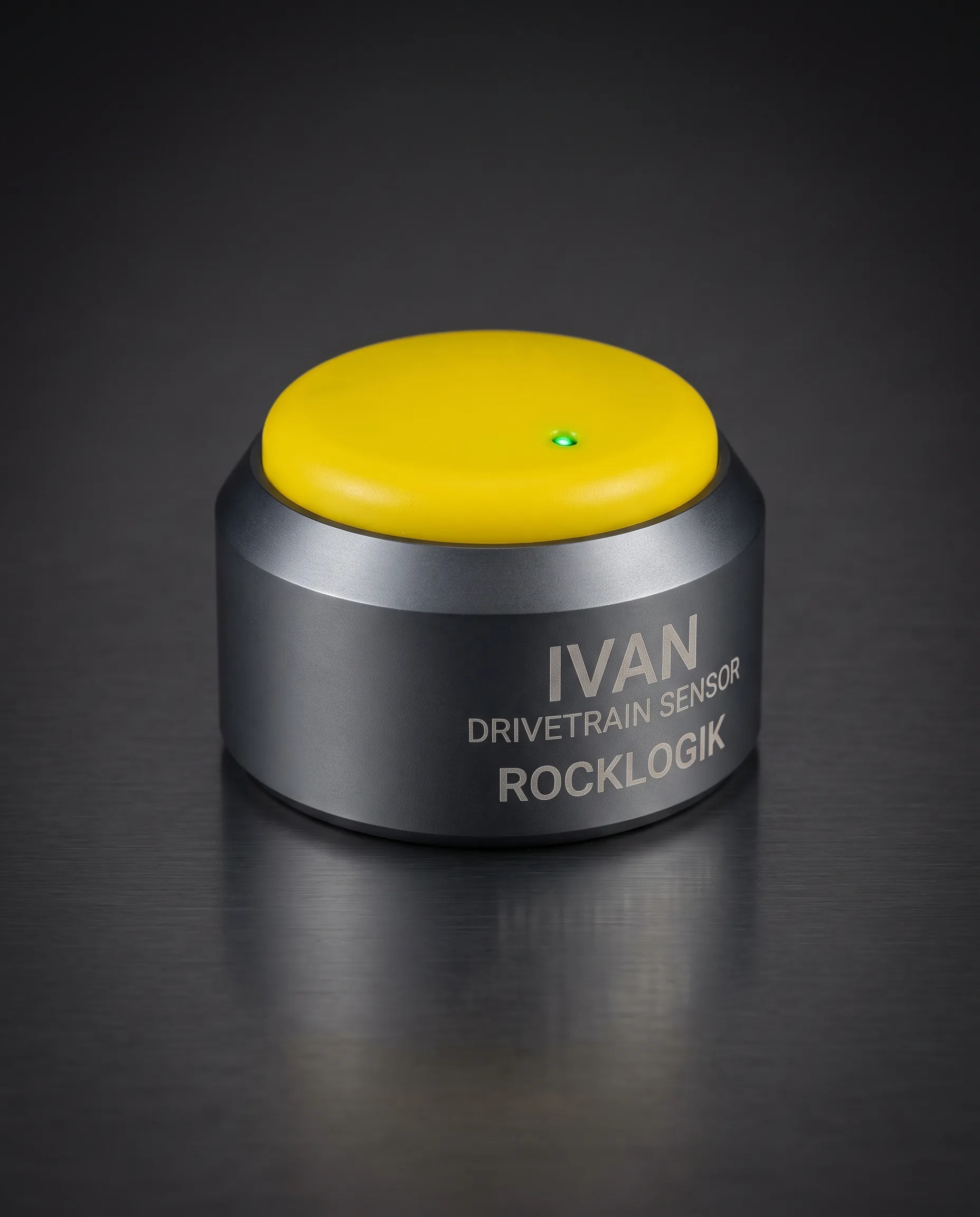
Studio photograph of the IVAN drivetrain sensor: a squat dark-grey aluminium puck with a domed yellow cap and a green status light, sitting flat on its base, etched IVAN, drivetrain sensor, RockLogik.
Architecture

How it fits together

Sensors talk to the hub over Bluetooth. The hub talks to the cloud over whatever the site has. The cloud talks to your planner.

Drivetrain sensor

IVAN

Industrial Vehicle Advanced Notification

Built like the axle it sits on.

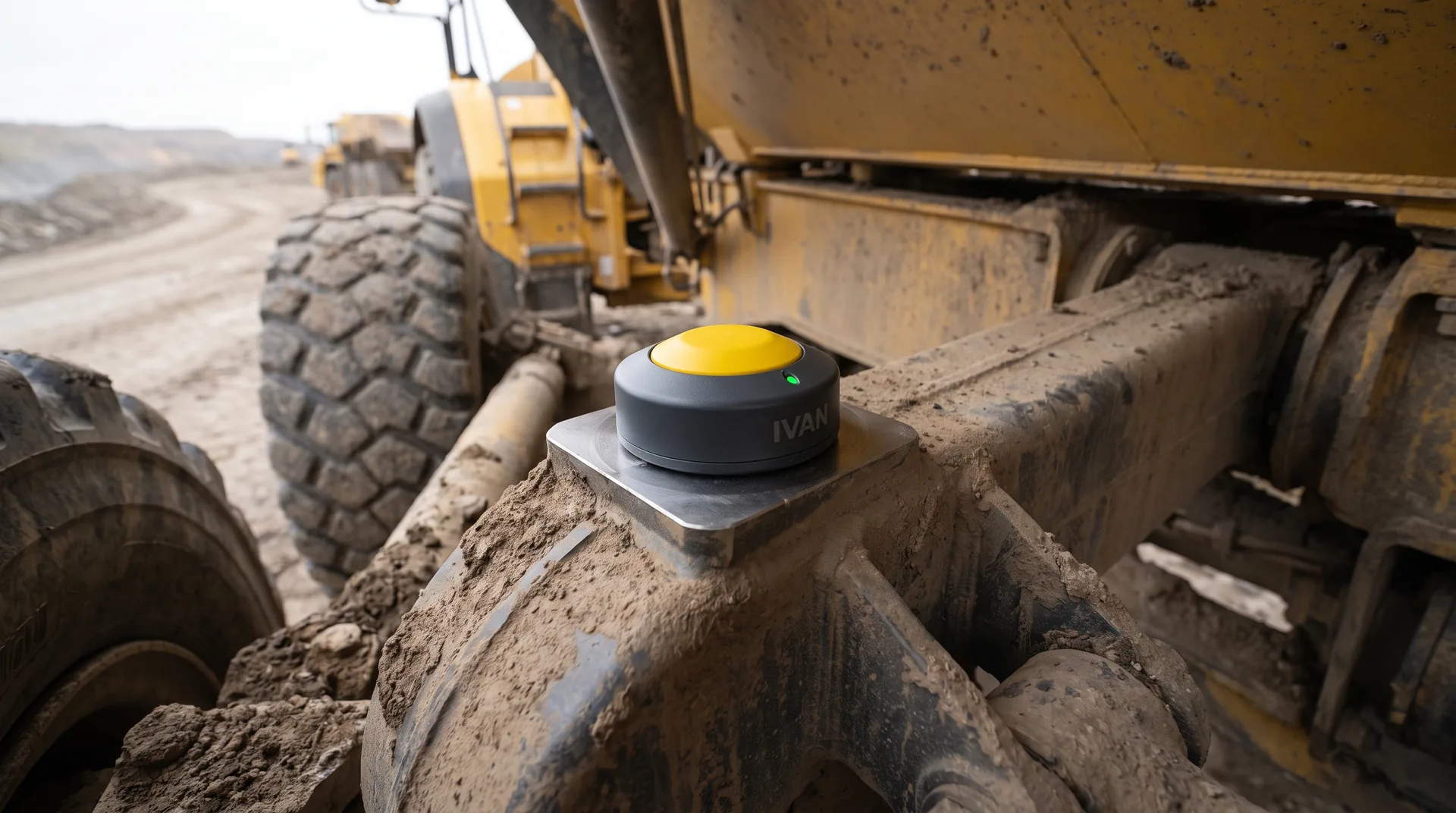
A small IVAN sensor sitting flush on a machined pad on the muddy axle housing of an articulated rock truck, with the tyres and haul road behind.
Ask about IVAN

A solid block of machined aluminium, potted through, with no cable, connector or charging port to fail. It sits flush on the transmission, transfer gearbox, differentials and suspension, takes the rock strike and the pressure washer, and keeps working from −40 °C mornings to a 90 °C housing. It captures vibration when the truck is in a comparable operating window, computes the diagnostic features on board, and reports to the hub in the cab by radio. Built to outlast the component it watches.

What you get

  • Wideband triaxial vibration to 10 kHz, so early bearing and gear faults are in range
  • Magnetometer shaft-speed reference for order tracking under changing speed and load
  • Features computed on the sensor; kilobytes leave it, not megabytes
  • Primary lithium cells, field replaceable, multi-year life, no charging
  • Machined from a single aluminium billet and potted solid: sealed to IP67, shock and vibration qualified, −40 °C to +85 °C
  • No cable, no connector, no charging port: the three things that fail first on field electronics are not there
  • Sits flush on a machined pad, bolted or bonded to the housing; nothing to catch, nothing protrudes

Built to last

Solid aluminium, one joint
The housing is machined from a single aluminium billet. The only joint is under the cap, and it carries an O-ring. Nothing else on the outside can open, crack or leak.
Potted solid
Inside, every component is encased in potting compound. There is no air space, nothing to shake loose, and nothing for water to reach even if it got past the seal. It is a solid block that happens to think.
No cable, no connector, no charging port
The three things that fail first on field electronics are simply not there. Power is a sealed cell inside the housing and data leaves by radio through the cap.
Takes the rock strike and the pressure washer
Sealed to IP67 and qualified against the shock and random-vibration profiles written for equipment bolted to off-highway vehicles. Wash the truck; leave the sensors on.
−40 °C to +85 °C, no heater
Primary lithium cells keep their capacity through a northern winter and never need charging, which is how every rechargeable field device dies in the cold.
Low, flush, out of harm's way
45 mm across and 28 mm tall, sitting flat on its pad with nothing to catch. If the housing it is bolted to survives the shift, so does the sensor.

Specification

IVAN specification
Vibration Triaxial wideband accelerometer, DC to 10 kHz, ±50 g, on a rigid base pedestal. Low-rate six-axis IMU for orientation and regime context.
Shaft-speed reference Three-axis magnetometer reading flux leakage from the rotating shaft. Gives the order-tracking reference without touching the shaft.
Temperature Component surface through the mount, plus housing temperature, both trended against load.
Processing Nordic nRF52840, Arm Cortex-M4F with FPU. Order tracking, envelope spectrum and diagnostic features computed on the sensor.
Radio Bluetooth LE 5 to the Firefly hub. Features every capture; raw waveform bursts on request.
Capture Regime-triggered bursts. The sensor sleeps until the hub signals a comparable operating window, then records a few seconds at full rate.
Power Primary lithium (LiSOCl₂) cells, field replaceable, no charging. Multi-year service life at the standard capture schedule.
Housing Machined from a single aluminium billet; every component encased in potting compound; one O-ring joint under an impact-resistant, RF-transparent cap. No cable, connector or charging port anywhere on the outside. Sealed to IP67 and built for pressure washing.
Environment −40 °C to +85 °C operating, no battery heater needed. Qualified against the random-vibration and shock profiles written for equipment mounted on off-highway vehicles. Rock strike, mud, salt and hydraulic oil are the normal case, not the exception.
Mounting Flush on a machined mounting pad that is bolted or bonded to the component housing. The sensor threads into the pad from below, so nothing protrudes. Magnetic base for survey use only.
Size and mass Ø 45 mm × 28 mm including cap. 120 g.
In-cab hub

Firefly

One box in the cab. Everything else follows.

Ask about Firefly

Firefly collects from the sensors over Bluetooth, listens passively to the truck's own J1939 bus for gear, speed, load and temperatures, and sends the lot to the cloud over LTE or the site network. A sunlight-readable touchscreen shows the operator the state of every monitored component, in a word and a symbol, not just a colour.

What you get

  • Powered from the truck, protected against load dump and transients
  • Listen-only J1939 tap: reads the bus, never transmits on it
  • Operating-regime context that makes one vibration capture comparable with the next
  • LTE and site Wi-Fi with store-and-forward for out-of-coverage haul roads
  • 7-inch glove-operable touchscreen, dims at night
  • Up to 12 sensors per truck

Straight answer on the bus tap

The J1939 connection is listen-only at the hardware level: the transceiver cannot drive the bus, so there is no way for Firefly to send a message to the truck, faulty or otherwise. It plugs into the diagnostic port through a pass-through Y-cable, so existing telematics keep working. We confirm bus access against your warranty terms before installation, every time.

Specification

Firefly specification
Power 12 / 24 V vehicle supply with ISO 7637-2 transient and load-dump protection. Hold-up for a clean shutdown at key-off.
Sensor link Bluetooth LE central. Up to 12 IVAN sensors per hub.
Vehicle bus SAE J1939 / CAN 2.0B on a listen-only transceiver. The hub cannot transmit onto the bus. 9-pin Deutsch diagnostic connector with a pass-through Y-cable for existing telematics.
Backhaul LTE Cat-1 with Cat-M1 fallback; site Wi-Fi 802.11ac. Store-and-forward buffer for out-of-coverage sections of the haul cycle.
Display 7-inch sunlight-readable touchscreen, glove operable, automatic night dimming.
Positioning GNSS for haul-cycle segmentation and site mapping.
Storage Local buffer for 30 days of features and requested raw bursts.
Housing Cab-rated enclosure, RAM-compatible ball mount, −30 °C to +70 °C operating.
Integrations

Works with what you already run

Your planners already have a maintenance system, and your fleet already reports into a telematics portal. RockLogik shows up inside both. Nobody has to learn another dashboard to act on what the sensors find.

SAP PM and IBM Maximo

Maintenance system work orders

A RockLogik watch becomes a maintenance notification against the right equipment number, with the trend, the operating context and the recommended action in the long text. Your planner turns it into a work order as usual, and what the mechanic found comes back to us and closes the loop.

  • Notifications, not work orders: your planner stays in charge of scheduling
  • Runs through a small connector inside your network, outbound only, so nothing new faces the internet
  • One notification per component and fault, updated as the trend moves, never duplicated
  • Email and CSV for sites that do not run a CMMS

ISO 15143-3 (AEMP 2.0)

Mixed-fleet telematics feed

RockLogik publishes in the same telematics standard the truck manufacturers already expose, so your fleet aggregator pulls it like any other source. A drivetrain watch appears as a fault code on the same truck, in the screen your fleet team already has open.

  • Fleet snapshot and per-truck history, in JSON or XML
  • Fault codes carry the component, severity and recommended action
  • Location and operating hours from the hub, alongside the manufacturer feeds
  • Same credential as the API, read-only

JSON over HTTPS, OpenAPI documented

Open REST API

Everything the dashboard shows is available to your own tools. Webhooks push a watch to a URL of your choosing the moment it is raised. Your data is yours to pull, on your schedule, in a documented format.

  • Assets, monitoring points, open items, trends and maintenance events
  • Webhooks for every change to an open item, signed and replayable
  • OAuth 2.0 client credentials, scoped per integration, revocable by you
  • Our own dashboard is a client of the same API, so nothing is held back

Tell us which maintenance system and which fleet portal your site runs and we will confirm the fit before the mounting survey. Ask about integration →

Pricing

Per instrumented truck, per year

One number per truck, per year, and everything on this page is inside it.

What the annual price includes

  • IVAN sensors and the Firefly hub
  • Installation and the baseline programme
  • Cloud analysis, dashboard and alerts
  • Sensor replacement for the life of the contract

Quoted per fleet after the mounting survey. There is no separate hardware invoice.

Get a quote

Tell us the site, the truck count and the makes, and we will come back with a mounting survey date and a per-truck figure.

Request a quote →