The breakdown could have been caught weeks earlier.
RockLogik puts industrial sensors on the transmission, transfer gearbox, differentials and suspension of every rock truck in your fleet, and watches them continuously. A bearing that is starting to fail becomes a trend on a named component and a scheduled shop visit, not an emergency repair on the haul road.
- 6
- drivetrain locations per truck
- Real time
- not a monthly report
- Any OEM
- mixed fleets welcome
$1M+
The engine in a large haul truck
With a core charge of $400,000 that is simply lost when a rod goes through the block. The drivetrain behind it is not cheap either, and it is the part nobody instruments.
Millions per hour
What a stopped operation costs
When a truck fails mid-cycle it takes a loader, a crew and a section of the pit plan down with it. Leases, labour and fixed costs keep running while production does not.
18,000 hours
Where the wear curve turns
Component wear is flat for a very long time, then falls off a cliff. A truck that needs a light overhaul at 18,000 hours needs a very deep one at 22,000. Knowing which side of the curve you are on is worth a great deal.
The parts that break, instrumented
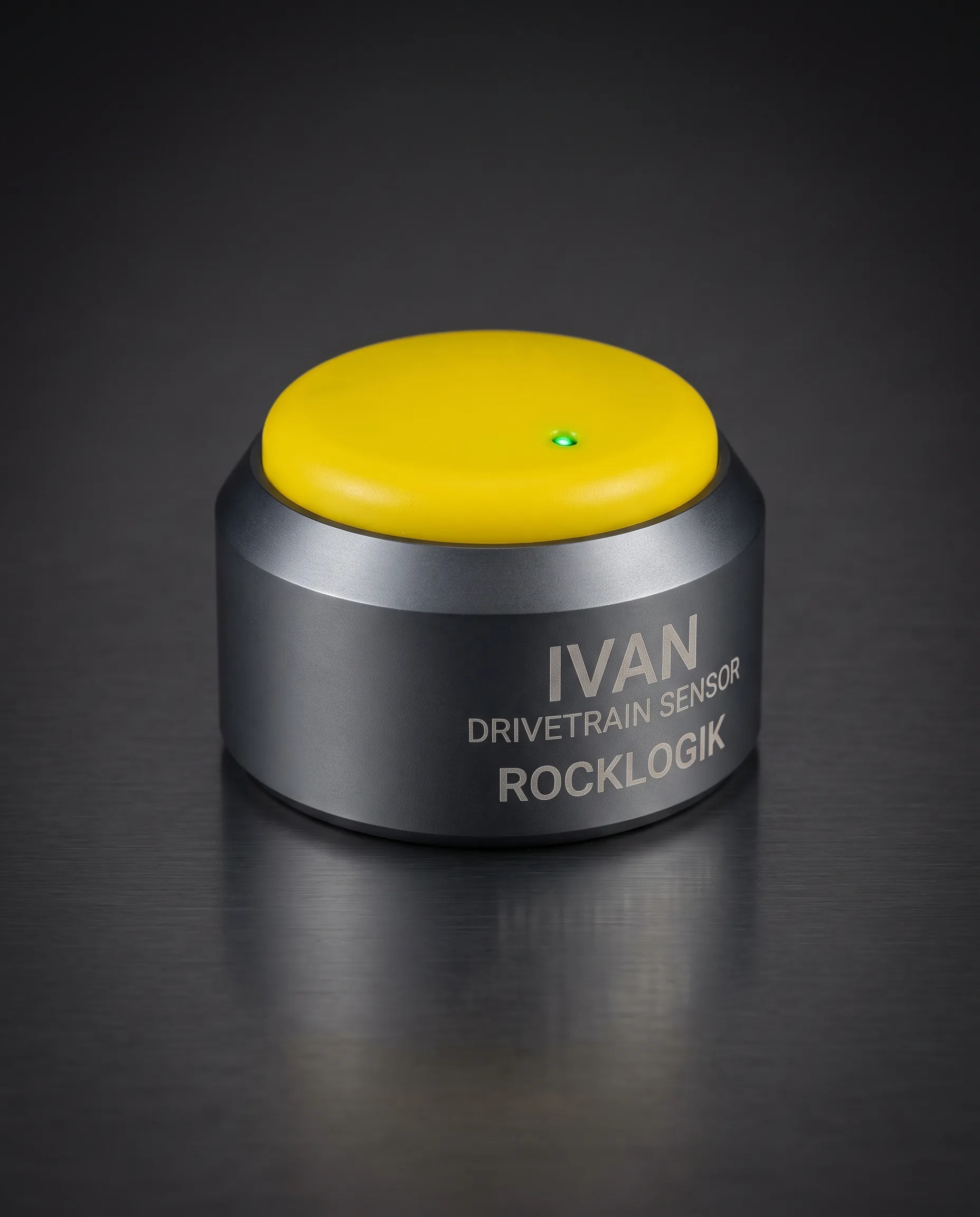
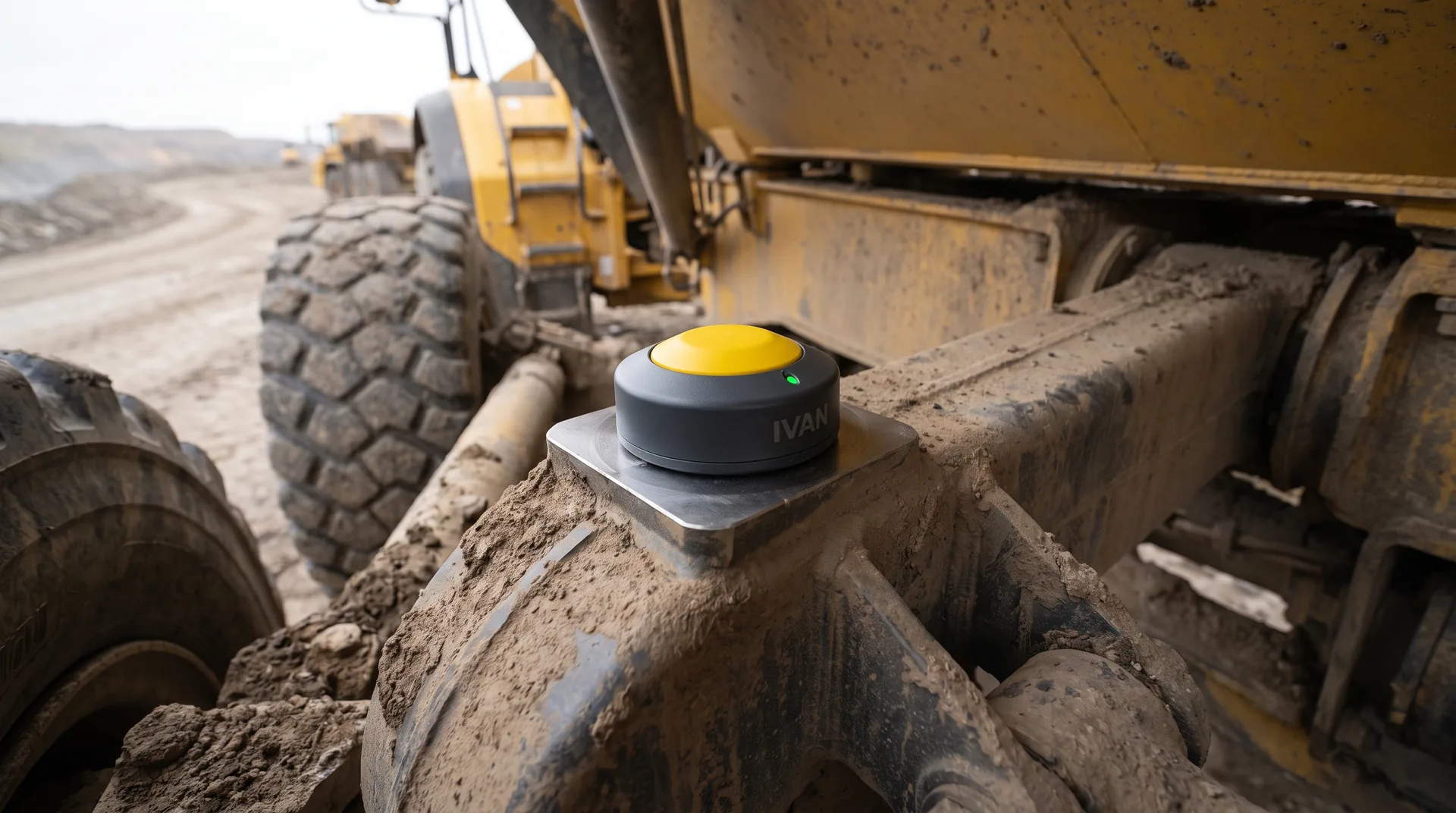
Six IVAN sensors mounted flush along the drivetrain and one Firefly hub in the cab. Fitted in a shift, and it works on whatever trucks you already run.
Transmission
Output shaft and idler bearings, gear mesh and its sidebands, oil temperature against load.
Transfer gearbox
The drop box at the hitch that splits drive to both frames. Bearing defect orders and mesh.
Differentials
Front, inter-axle and rear. Pinion and carrier bearings, ring-and-pinion mesh, housing temperature.
Final drives and wheel ends
Planetary and wheel-bearing signatures at hub-rate orders.
Driveshafts
Universal joints and centre bearings, and the imbalance they cause when they wear.
Suspension
Walking-beam pivots and strut mounts, tracked as changes in the structural response.
The engine is monitored. The drivetrain is a guess.
The condition-monitoring programmes that come with a truck cover the engine and some hydraulics, report on a monthly cycle, and follow one manufacturer's equipment. What is the use of knowing there was an oil-pressure warning three weeks ago? Meanwhile the transmission, the transfer case and the differentials are inspected by ear, by oil sample, or by the failure itself.
RockLogik is the drivetrain layer: continuous, real time, and independent of who built the truck.
What the sensors actually measurePhysics on the sensor, judgement in the cloud
Three steps between a bearing starting to wear and a planner seeing it on a screen.
How RockLogik is trained, and how it works
Why a haul truck defeats ordinary vibration analysis, how the sensors make the signature hold still, and how the system learns a fleet's normal before it judges anything against it.
Read the transcript Hide the transcript
Every defect in a bearing or a gearbox has a frequency, and every one of them is a multiple of shaft speed. On a rock truck, shaft speed changes every few seconds. Loading, hauling, dumping, returning, queueing. Five regimes, five different signatures from the same healthy gearbox. Average them together and a fault disappears into the noise. RockLogik fits six IVAN sensors flush along the drivetrain, and one Firefly hub in the cab. Firefly listens to the truck's own bus for gear, speed, load and grade. It only listens; it never transmits. When the truck enters a known operating window, loaded on grade in third, say, it tells the sensors to capture. Each sensor records a few seconds at full bandwidth. Its magnetometer reads the rotating shaft through the housing, so the vibration is resampled against shaft angle, not time. Bearing and gear frequencies land at fixed orders, whatever the speed. The sensor computes the diagnostic features on board: bearing defect orders, gear mesh and sidebands, the envelope spectrum where early faults live. Kilobytes leave the sensor, not megabytes. Then the system learns. For eight to twelve weeks it records what normal looks like for every truck, at every location, in every regime. Nothing is judged yet. Your work orders and teardown reports go into the same timeline. Before it goes live, it runs in shadow: it logs what it would have said, and your planners check that against what actually happened. Watch levels are set with your team, on evidence. A false alarm costs more trust than a miss. Then it goes live. Every capture is scored against its own baseline. A defect order climbing out of it raises a watch on a named component, with the trend and a recommended action. In the cab and on the dashboard, every component carries a symbol and a word, never a colour alone. Most watches resolve at the next scheduled service. Critical is rare by design. A watch becomes a notification in your maintenance system. What the mechanic finds comes back and sharpens the model. Each inspection makes the next call better. RockLogik. Physics on the sensor, judgement in the cloud, and a breakdown that becomes a scheduled shop visit instead.
Capture in a known regime
A rock truck is never at steady speed, and vibration signatures smear when speed changes. Firefly reads gear, speed and load from the truck's own bus and tells the sensors when the truck is in a comparable window. Every capture is then like the last one.
Compute on the sensor
IVAN records a few seconds at full bandwidth, tracks the shaft with its magnetometer, and computes the diagnostic features on board: bearing defect orders, gear mesh and sidebands, envelope spectrum, band energy. Kilobytes leave the sensor.
Trend against a learned baseline
The cloud holds a baseline for every truck, location and regime, learned during the first weeks. A defect order climbing out of its baseline raises a watch on a named component with a recommended action, in time for the next service window.
Order tracking, envelope analysis and regime segmentation are standard condition-monitoring practice on fixed plant. Making them work on a machine that never holds a speed is the engineering on the how-it-works page.
Built for the worst place on the truck
A differential housing on a haul road is about the harshest place you can put electronics: rock strike, pressure washing, mud, −40 °C mornings and a housing at 90 °C by noon. IVAN is built for exactly that, and nothing else.
Solid aluminium, one joint
The housing is machined from a single aluminium billet. The only joint is under the cap, and it carries an O-ring. Nothing else on the outside can open, crack or leak.
Potted solid
Inside, every component is encased in potting compound. There is no air space, nothing to shake loose, and nothing for water to reach even if it got past the seal. It is a solid block that happens to think.
No cable, no connector, no charging port
The three things that fail first on field electronics are simply not there. Power is a sealed cell inside the housing and data leaves by radio through the cap.
Takes the rock strike and the pressure washer
Sealed to IP67 and qualified against the shock and random-vibration profiles written for equipment bolted to off-highway vehicles. Wash the truck; leave the sensors on.
−40 °C to +85 °C, no heater
Primary lithium cells keep their capacity through a northern winter and never need charging, which is how every rechargeable field device dies in the cold.
Low, flush, out of harm's way
45 mm across and 28 mm tall, sitting flat on its pad with nothing to catch. If the housing it is bolted to survives the shift, so does the sensor.
Built to outlast the component it watches. The full specification →
One hub per truck
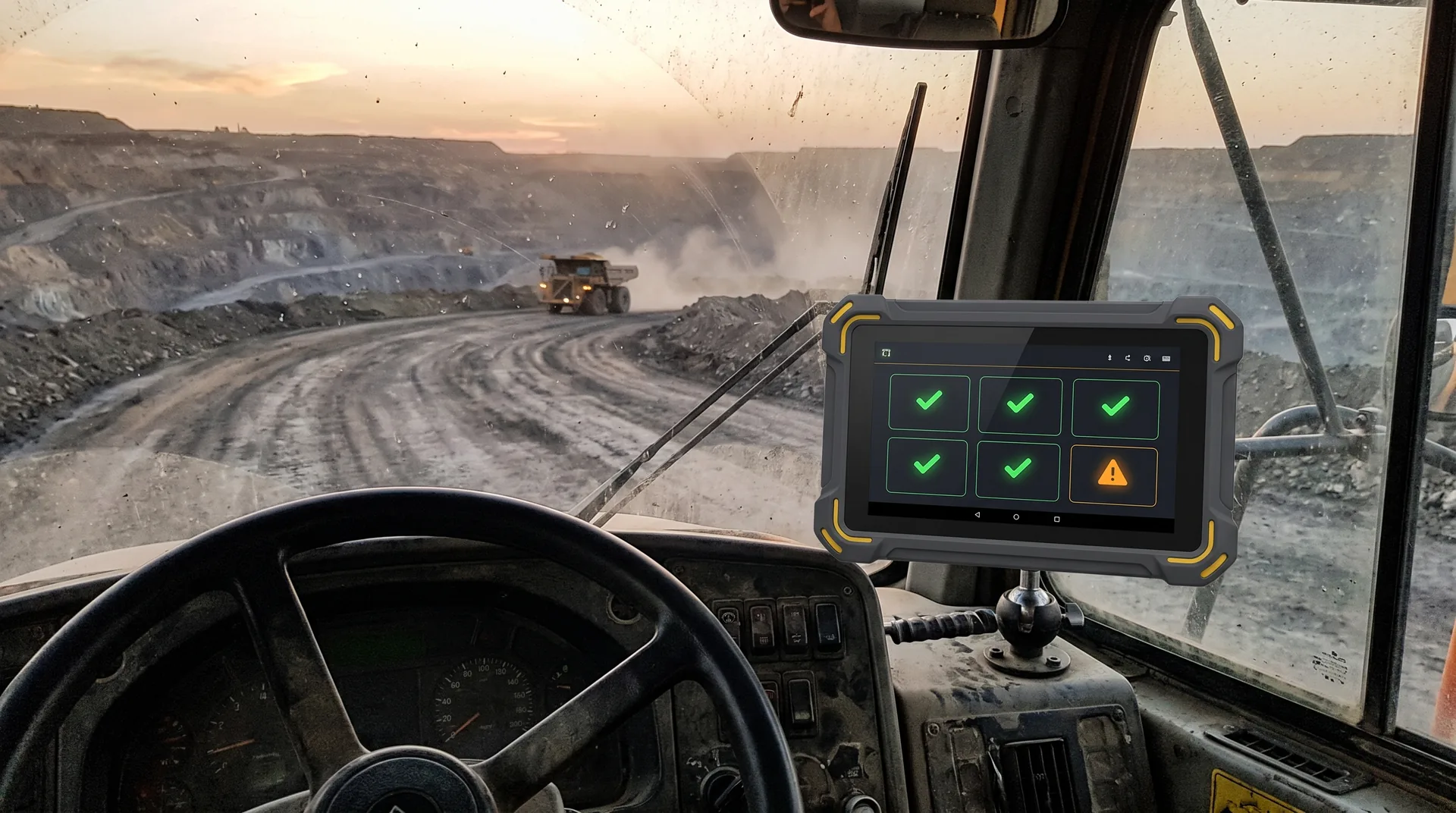
Firefly shows the operator every monitored component in a word and a symbol, and a rising trend before it is a problem. It also does the quiet work: powering from the truck, listening to the J1939 bus, and getting the data off the site.
- Powered from the truck, protected against load dump and transients
- Listen-only J1939 tap: reads the bus, never transmits on it
- Operating-regime context that makes one vibration capture comparable with the next
- LTE and site Wi-Fi with store-and-forward for out-of-coverage haul roads
- 7-inch glove-operable touchscreen, dims at night
- Up to 12 sensors per truck
A trend, a part, a next step
The fleet dashboard sorts trucks by attention. An open item is a trend on a named component, the operating context it was measured in, and a recommended action your planner can turn into a work order.
- Watch, advisory and critical levels set with your maintenance team
- Every state shown as a glyph and a word, never a colour alone
- Warranty hours tracked so a failing part is caught while it is still covered
- Work orders into your maintenance system, alerts to a phone
Already have a maintenance system and a fleet portal? RockLogik shows up inside both: SAP PM and Maximo work orders, an ISO 15143-3 (AEMP 2.0) telematics feed, and an open API. How it integrates →
Two devices, one system
Sensors on the components and a hub in the cab. Nothing else goes on the truck.
Built for the trucks you already run
RockLogik is retrofit and manufacturer-independent. The same sensors and the same hub go on every make on the site, and one dashboard shows all of them.
- Articulated haulers, 25 to 45 t
- Cat 725 to 745, Volvo A25 to A60, Bell B25 to B60, Komatsu HM300 to HM400, John Deere 260 to 460.
- Rigid haul trucks
- Mechanical-drive rigids such as Cat 777 to 785, Komatsu HD785. Electric-drive classes are on the roadmap.
- Quarry and aggregate fleets
- Mixed fleets across brands, which is where an OEM-locked programme cannot follow you.
Surface operations. Underground and explosive-atmosphere certification is outside the current scope.
How a site starts
-
1
Baseline 8 to 12 weeks
We survey the trucks, agree the sensor locations and mounting, fit the sensors and the hub, and record. The system learns what normal looks like for each asset, each location and each operating regime, and we pull maintenance records into the same timeline.
-
2
Monitor from week 12
With the baseline learned, the same sensors start judging against it. The system runs in shadow first, logging what it would have said, then goes live with watch and advisory levels chosen with your maintenance team. Every alert is a trend on a named component with a recommended action.
-
3
Fleet ongoing
Coverage expands across the fleet and integrates with your maintenance system, so a watch becomes a work order. Each quarter we report what was caught, how far ahead, and what it was worth.
Because downtime isn't an option.
One differential caught before it seizes pays for the fleet's monitoring for the year. Tell us about your trucks and we will come and look at them.